
DigiAdvance joins Cedefop & Eurofound 50th Anniversary Event: Skills and jobs: How SMEs go digital. The event was meant to present the key challenges and barriers SMEs face in becoming more digital and review digitalisation and digital skills support measures
The first part of the session was dedicated to the presentation of Eurofound and Cedefop’s 2025 research report showing that SME digitalisation in Europe is progressing, but unevenly across countries and firm sizes. As of 2024, 73% of EU SMEs had reached at least a basic level of digital intensity (using at least 4 out of 12 key digital technologies/practices), while only Denmark and Finland had already met the EU’s 2030 target of 90%. The report highlights a persistent north/west vs south/east divide, and notes that many SMEs still digitalise reactively—driven by shocks like COVID-19, labour shortages, or regulatory changes—rather than through long-term strategy.
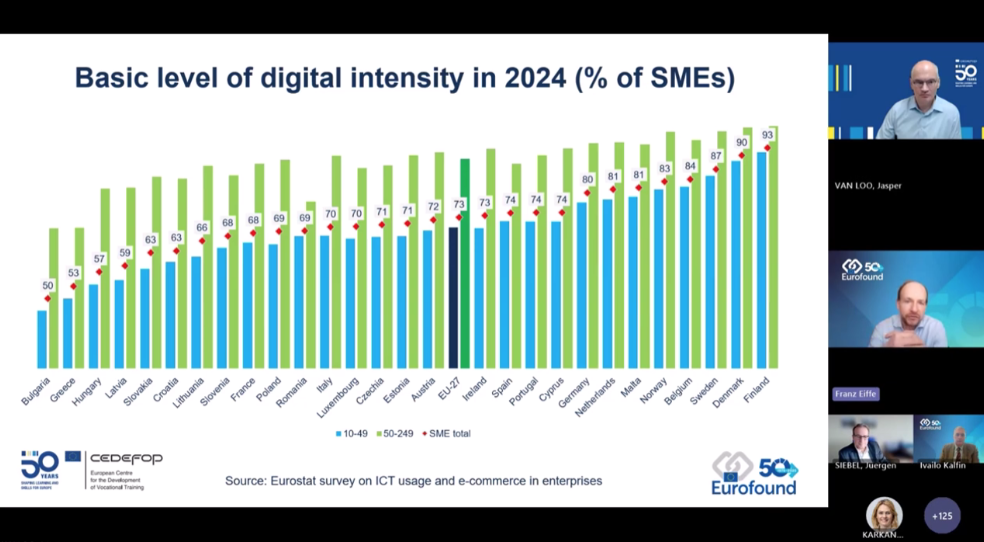
A major takeaway is that skills and capacity are the bottleneck: limited digital skills, difficulty recruiting ICT specialists, and low use of skills assessment tools slow down adoption—especially for smaller firms and in traditional sectors. While tools like e-commerce, remote access and social media have expanded (e.g., SME e-commerce engagement rose from 13% to 20% between 2010 and 2024), more advanced uptake remains modest: around 13% of SMEs used at least one AI technology in 2024, with higher rates in digitally mature countries and larger firms.
The report also links digitalisation to working conditions: it distinguishes between workplaces using digital tools to support collaboration, those focusing on automation and monitoring, and those with low digital intensity, warning that the last group is especially disadvantaged in autonomy and access to training. Policy-wise, it calls for coherent strategies aligned with the Digital Decade, stronger digital infrastructure, simplified and accessible support (notably agile voucher schemes), targeted digital skills development, and a responsible approach to technology that boosts productivity without harming job quality.
Moderated by Jasper van Loop, the second part of the session featured an open debate with European digital-skills experts, including Valentina Guerra (Policy Director at SMEUnited), Ants Sild (Lecturer-Consultant, BCS Digital Skills Academy, Estonia), Thomas Oberholzner (Director, KMU Forschung Austria), and Dr. Mairéad Nic Giolla Mhichíl (Coordinator of DigiAdvance).
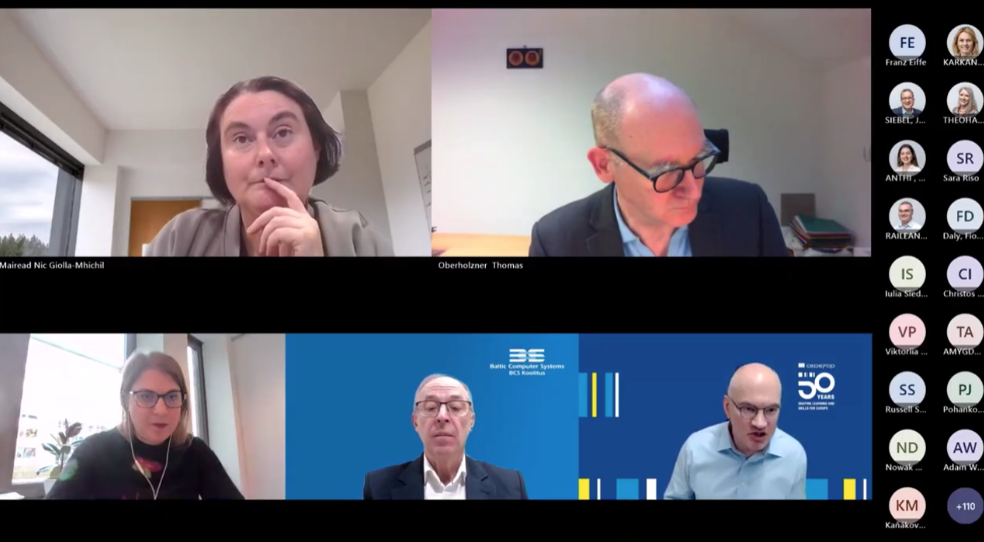
She explained that these insights, together with evidence gathered through events, networking activities, and in-depth interviews with SME managers, have helped shape DigiAdvance’s training offer: a catalogue of 40 university-developed courses spanning a wide range of technologies. Dr. Mairéad Nic Giolla Mhichíl also explained how micro-credentials are being used in Ireland to support digitalisation and to drive upskilling and reskilling, an approach that, according to the moderator, positions Ireland as a frontrunner and a source of inspiration in this area.
Access to the report here.
More about the session here.